Skip to content
Diaphanic

Services · Build

AI integration services, with the cost per answer known.

AI is useful when it does a specific job well and costs less than it saves. We design the feature, send each request to the right model, and track the cost per answer from day one.

Who it's for

Is this you?

How it works

How an assistant answers from your own documents.

The model is the smallest part of an AI feature. Most of the work, and most of the saving, is in what happens before and after it is called.

How an assistant answers from your documents

01 / 06

Step 01

Your documents are indexed once

Manuals, policies, price lists and past answers are split into passages and stored so they can be searched by meaning, not only by exact words.

What we do here

The index stays in your infrastructure. We choose providers and settings that don't train on your data.

Step by step

What we do, in order.

Each step ends with something you can read, check and approve before the next one starts.

The full method
  1. 01We pick one job, and how to measure it

    Phase 01 · Research
    What we do
    Find the task where AI would save real time, and agree what a good result looks like.
    You receive
    A written plan: the job, the measure of success and the expected cost per use.
    Why it matters
    “Add AI” has no finish line. One measured job does.
  2. 02We prepare your material

    Phase 02 · Plan
    What we do
    Collect the documents the AI should answer from, clean them and index them for search.
    You receive
    A list of what's in the index, and what was deliberately left out.
    Why it matters
    An assistant is only as good as what it's allowed to read.
  3. 03We build and test the retrieval

    Phase 04 · Build
    What we do
    Tune the search on your real questions, and check the results against answers you've marked as correct.
    You receive
    Test results you can read: question, answer, source.
    Why it matters
    Most wrong answers come from finding the wrong passage, not from the model.
  4. 04We route and cache

    Phase 04 · Build
    What we do
    Send simple requests to small models, keep repeated answers in a cache and run independent steps in parallel.
    You receive
    A cost per answer, measured before launch.
    Why it matters
    The same feature costs many times more when every request goes to the largest model.
  5. 05We add the guard rails

    Phase 04 · Build
    What we do
    Show sources with every answer, and make the assistant say when your documents don't cover a question.
    You receive
    An assistant your staff can check, and correct.
    Why it matters
    People only keep using a tool they can trust.
  6. 06We launch with the meter running

    Phase 05 · Launch
    What we do
    Put it into your product with usage and cost tracking switched on.
    You receive
    Usage and cost figures you can read at any time.
    Why it matters
    You can prove the feature pays for itself, or switch it off.

What you get

Concrete deliverables, not promises.

Everything below is yours, written down and handed over.

  • A written plan: the job the AI does, how we'll measure it, and the expected cost per use
  • The feature built into your product: an assistant, search, drafting or review
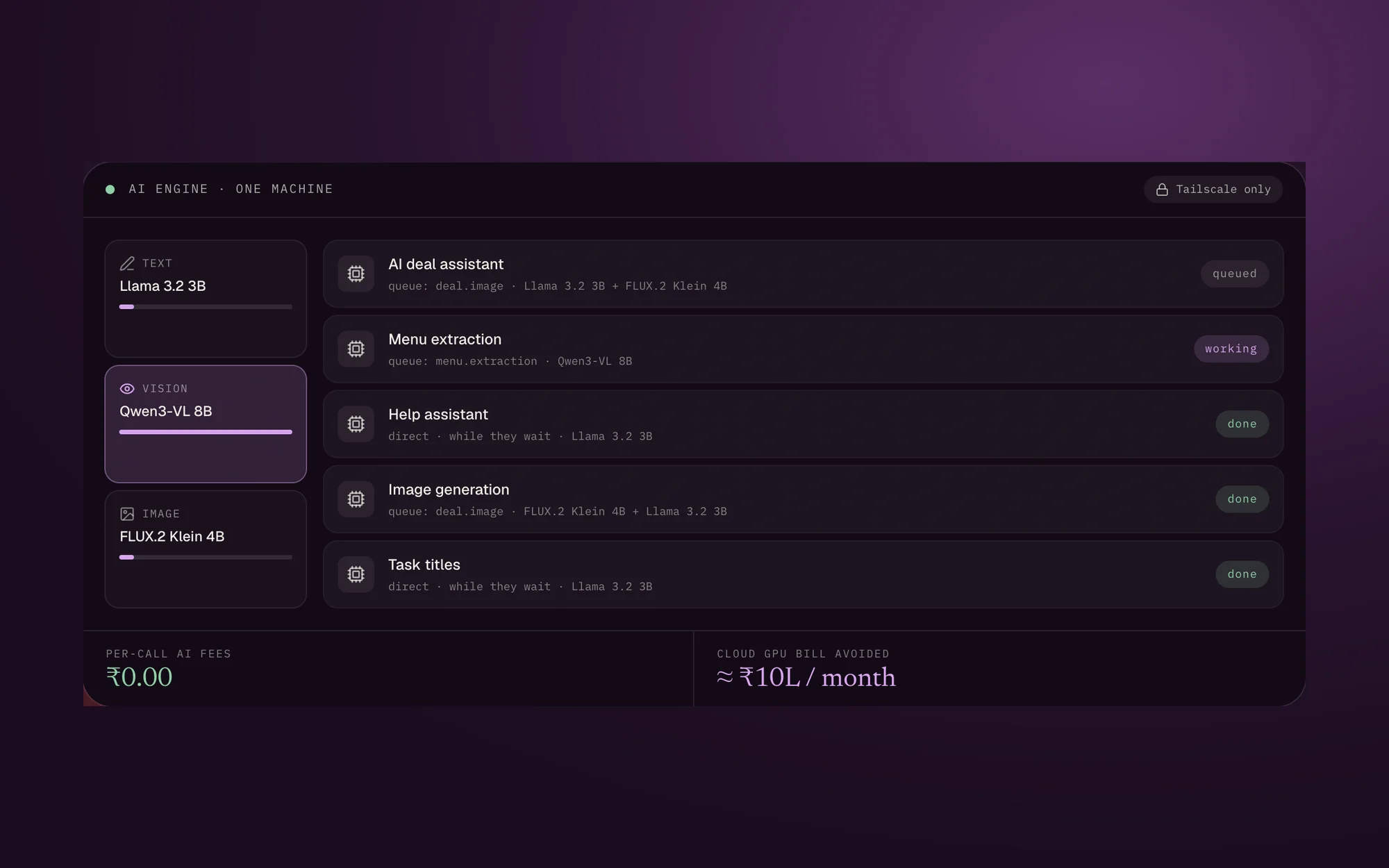
  • Model routing, so simple requests go to cheaper models
  • Usage and cost tracking
  • Self-hosted open-weight models where privacy or cost calls for it

What the work is for

Each effort, and what it changes.

An AI feature should be able to justify itself on one page.

  • The effortThe model reads only the passages that matter

    What it changesAnswers come from your own documents, and can be traced back to them.

  • The effortEasy questions go to small models

    What it changesMost requests cost a fraction of what the largest model would charge.

  • The effortRepeated questions are answered from a cache

    What it changesCommon answers are instant, and free.

  • The effortCost per answer is tracked from day one

    What it changesYou know what the feature costs and what it saves, and the bill never surprises you.

For your technical team

The detail, written down.

The details your engineers and your security lead will want.

How we engineer
Models
Commercial LLM APIs and open-weight models, matched to each task by quality, speed and price.
Self-hosting
Open-weight models served with Ollama on a private GPU server, reachable only over a WireGuard tunnel, where privacy or cost calls for it.
Your data
Providers and settings that don't train on your content. The index stays in your infrastructure.
Retrieval
A RAG pipeline: documents split, embedded and searched by meaning, with sources returned.
Throughput
RabbitMQ for long-running jobs and Redis for caching, so the product stays responsive.
Cost control
Routing by difficulty, cached answers, parallel steps and a logged cost for every request.
Testing
A set of your real questions with approved answers, re-run whenever something changes.

Stack

  • LLM APIs
  • RAG pipelines
  • Ollama (self-hosted)
  • RabbitMQ
  • Redis
  • Node.js

Related work

Where we've done this.

Understand it first

Guides on this subject.

Plain-language explanations, with the questions worth asking any supplier.

Questions

What clients ask us.

Also from the studio

Often paired with

Start a project

Tell us aboutyour business.

Send us what you do and what you want to achieve. You’ll get a clear reply within one working day — questions or a next step, not a sales deck.

Not ready for a project? Start with something free, and judge us on what comes back.

  • Reply within one working day
  • A fixed, written quote first
  • Australia · Canada · India
  • contact@diaphanic.com