Skip to content
Diaphanic

Guides · Websites

What makes a website fast, and why it matters

Speed is treated as a technical detail. For a business it is closer to an opening hour: if the page hasn't appeared, you are shut.

The short version

  • Most visitors arrive on a phone, on mobile data. Test there, not on an office computer.
  • Slow sites are usually slow for ordinary reasons: oversized images, heavy scripts, a distant server.
  • Google measures speed on real visits and uses it when it ranks pages.

Updated November 2026 · 3 sections · 1 drawing

The picture

The whole thing, one step at a time.

The drawing plays through on its own. Pick a step to stop on it.

What happens after a tap

01 / 06

Step 01

The phone asks where your site lives

A domain name is only a label. The phone first has to look up the address behind it, and a slow or misconfigured lookup delays everything after it.

What we do here

Your domain and DNS sit in your own account, configured once and documented.

01

Why speed is a business number

A visitor who taps your link from a search result has other results one tap away. They don't wait out of loyalty. If nothing useful has appeared within a few seconds, a share of them go back and choose someone else, and you never learn they were there.

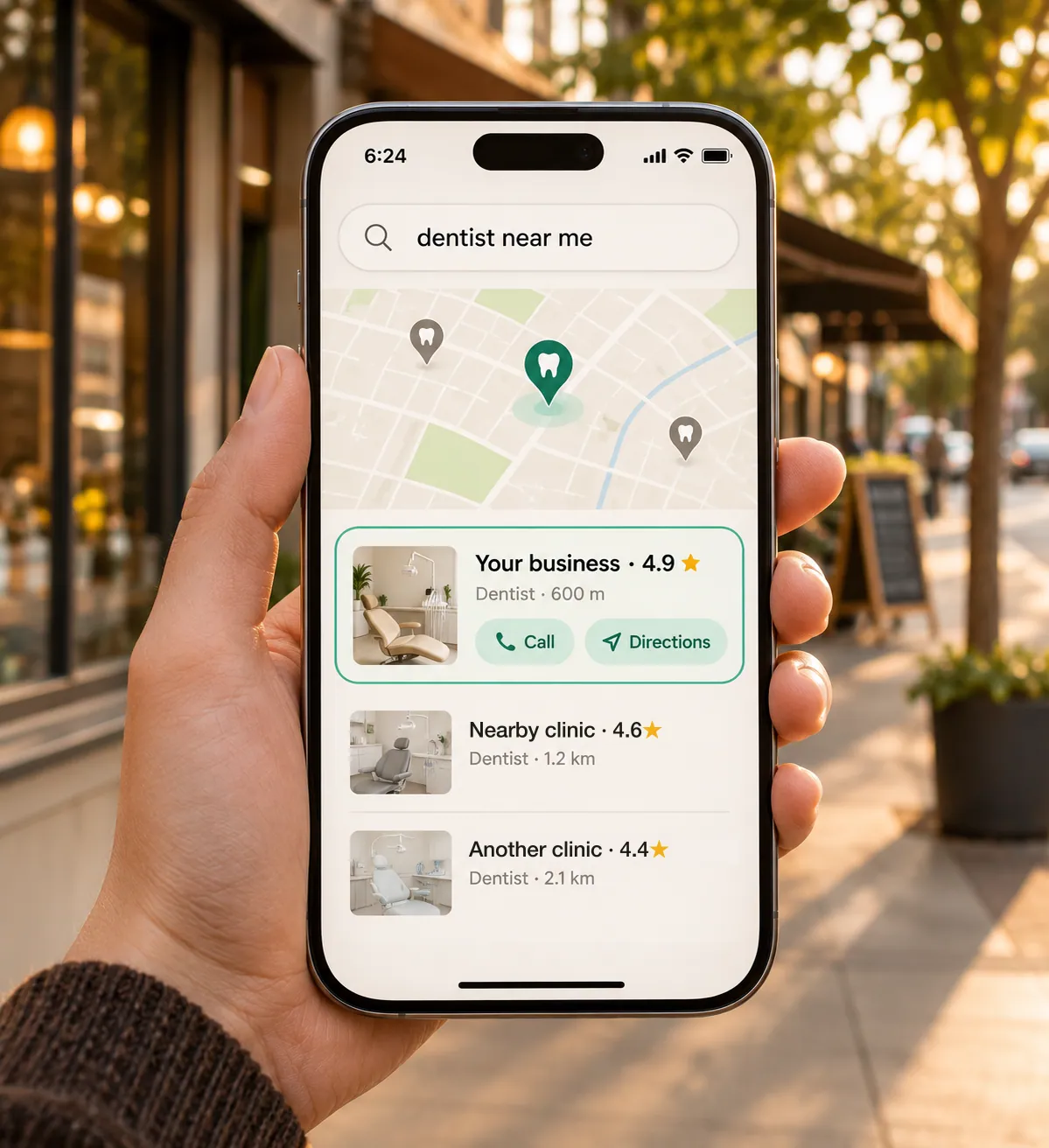
We rebuilt a dental clinic's website whose main content took 22.8 seconds to appear on a phone. Nothing about the clinic was wrong. People were giving up before they saw it. After the rebuild the same content appears in 2.7 seconds.

Speed also counts in search. Google measures how real visitors experience your pages and uses that as one of its ranking signals, so a slow site pays twice.

02

Where the seconds go

A page can be slow in several places, and the fix is different for each. The server may be far from the visitor. The page may arrive as an empty shell that the phone has to assemble. The images may be many times larger than the screen needs.

The commonest cause is weight. Page builders and templates load code for every feature they offer, whether your page uses it or not. A site built for your pages alone sends only what those pages need.

Fonts and images cause a second problem: the page jumps as they arrive, and the button you were about to tap moves. That is measured, and penalised, too.

03

How it is measured

Google uses three measurements, together called Core Web Vitals. One is how long the main content takes to appear. One is how much the layout shifts while loading. One is how quickly the page reacts when you tap.

Google publishes a free tool, PageSpeed Insights, that scores any address. Run your own site through it, choose the mobile tab, and look at the numbers before anyone tries to sell you anything.

A score from a fast laptop on office wifi tells you little. The honest test is a mid-range phone on mobile data, because that is what your customers are holding.

Words you'll hear

The jargon, translated.

Six terms a supplier is likely to use in the first meeting.

LCP
Largest contentful paint: how long until the main content is visible.
CLS
Cumulative layout shift: how much the page jumps about while it loads.
INP
Interaction to next paint: how quickly the page responds when you tap.
CDN
A network that keeps copies of your site in many cities, so it is served from nearby.
Server rendering
Building the finished page on the server, so the phone receives something it can show at once.
Lighthouse
Google's testing tool. It scores speed, accessibility, good practice and SEO.

Before you sign anything

Questions to ask any supplier.

Including us. A supplier who is comfortable with these is usually worth talking to.

Ask us
  1. 01What does my current site score on a mid-range phone, on mobile data?
  2. 02Will the pages be built on the server, or assembled in the visitor's browser?
  3. 03What speed are you aiming for, and will you show me the test before launch?
  4. 04What happens to my existing page addresses and their rankings?
  5. 05Who owns the hosting and the domain when we're finished?

Where we do this

Keep reading

More guides

Start a project

Tell us aboutyour business.

Send us what you do and what you want to achieve. You’ll get a clear reply within one working day — questions or a next step, not a sales deck.

Not ready for a project? Start with something free, and judge us on what comes back.

  • Reply within one working day
  • A fixed, written quote first
  • Australia · Canada · India
  • contact@diaphanic.com